Showing posts with label video. Show all posts

Friday, April 10, 2009

High Impact Video - With a 5-Pound Sledge

Screen shot from the Charlie the Cheapskate video showing a 5-pound sledge hitting a piece of Wilsonart Laminate flooringVideo is a great way to tell a story. The combination of visual and audio elements can have a great effect on the viewer. I believe the more entertaining the video is, the more impact it will have and the more it will be remembered. Videos can be very effective, even if you’re reaching out to a niche market. A great example of using video to reach out is “Wilsonart Flooring and Charlie the Cheapskate” by Spike and Dave.

Spike tells the story: “I have been in the flooring business since 1993 and Dave (the salesman in the video) has been in flooring since 2000. Both of us attended the Wilsonart Training in Temple, Texas a few years ago, since then we have pushed to sell Wilsonart because of the quality and the difference between HPL (High-Pressure Laminate) & DPL (Direct-Pressure Laminate)[flooring]. We were asked … to come up with something that would show how we sell the Wilsonart Flooring.”

How the two sell flooring is apparent throughout the short video. They talk about low price versus value, especially considering how HPL resists stains, spills and damage. They even go so far as to drop a sledge hammer head onto a piece of HPL laminate flooring. According to Spike, this is something they really do, “When customers come into our store we use the sledgehammer as a visual to show the impact resistance of the [Wilsonart] floor.”

From a marketing perspective, the video incorporates important elements of a successful video, including the “Call to Action” at the end to visit Wilsonart Flooring’s web site. It’s all done in a short, to-the-point, but very entertaining segment. “As an advertising manager, I think it's important to have something that people don't forget... so we created 'Charlie the Cheapskate', a story of a man that would shop around at the Big Box stores to get the cheapest price on flooring, until he was educated from a professional, on why one floor is cheap and another is not,” said Spike. I believe he did it right as the video he created could be used as a training tool for sales people as well as a spot to educate customers the difference between different kinds of laminate flooring.

Check out the video and see for yourself. Does it give you ideas how to use video in your business either as a training or promotion tool?


Video credit: spikegilley

Wednesday, March 25, 2009

How Are Your Digital Assets? - Stuff I Learned At PubCon South

At PubCom South in Austin, Brian Combs of Apogee Search, Amanda Watlington of Searching for Profit, Mike Grehan of Acronym Media and Jackie Bodine of Google made up an excellent panel entitled "Universal & Personal Search: This Changes Everything." I picked up quite a few ideas and action points from their presentations. Allow me to share some ideas with you.

Search Engine Results Pages (SERPS) have changed. No longer are there a few sponsored links on top, some to the side, then a list of "generic" or "natural" searches in a list taking up the main part of the page. Now there are links to images and videos with thumbnails to attract the eye along with "Shopping Results" and the "10-Pack" or "8-Pack" filling up the SERPS. If the searcher specifies a location in their search a number of links with a map image will also appear in the SERPS. All of those newer items sometimes crowd out the natural search results, which could bump your site down to the bottom of the first page or even to the second.

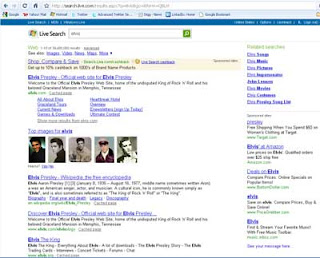
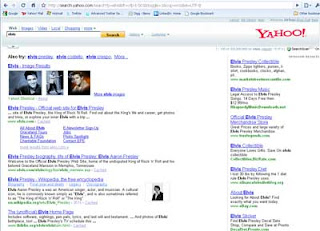
Because the human eye tends to focus on images first, SERPS with images will totally bust the traditional "Golden Triangle" or "Z" pattern of viewing as discovered in eye-tracking studies of the past. I'm going to use the example of searching for "Elvis" on Google, Live Search and Yahoo! to show how the images and video thumbnails look on SERPS which feature them. Click on the images below to see the actual web pages. Is your eye attracked to the images first? Mine were.

Google SERP on search for the word ELVIS

Live Search SERP on search for the word ELVIS


Yahoo! Search SERP on search for the word ELVIS
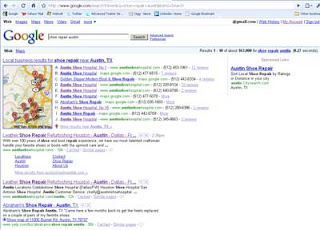
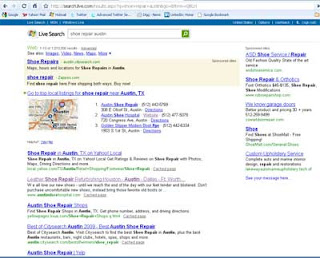
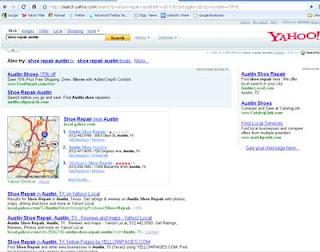
Here are some examples of SERPS where a location is included in the query. You can see how the map and "local" results change the SERPS:

Google search SERP on search for shoe repair in Austin, TX


Live search SERP on search for shoe repair in Austin, TX


Yahoo! search SERP on search for shoe repair in Austin, TX
Traditional web page only search optimization isn't going to cut it any more. If you have digital assets (in this case referring to images, videos and PDF files) they need to be optimized just like everything else on your web site. Here are some tips:
  • Inventory your digital assets so you know what you're working with.
  • Name digital files with a user-friendly, descriptive file name. "Chef Presentation of Banana Guacamole.jpg" is better than "img0900030233489a.jpg".
  • Optimize PDFs using the pieces in the "Description" tab in the properties box. I created a guide posted on our Intranet to help those in my company who create PDFs.
  • Create a video site map file for Google (http://www.google.com/support/webmasters/bin/answer.py?answer=80472&ctx=sibling).
Something to seriously consider is uploading your images to sites like Flickr and your videos to sites like YouTube. Even if you get your digital media files are indexed in Google, Yahoo! or Live image and video searches, you greatly increase your chances of people sharing and linking those files if they are on a site which specializes in such. Make sure to tag and describe the files thoroughly as well as make any copyright and trademark notices visible.

Videos need to have a call to action. It's good to set the profile the videos are uploaded to with a "Visit my website at www.mywebsite.com" message, but it's equally important to put that call to action somewhere in the video. This is because people can embed the videos into their own blogs or web pages, and they may not link to your site from their page. I think it's be a good idea to put the call to action at the beginning and the end of the video and at the bottom of each image.

The bottom line we must keep in mind is "Content is King." Content must be well-done, compelling and relevant to what your customers are searching for. All of the optimization is all for naught if you don't have good content.